
What Is Medical Scribing? A Practical Guide for Today’s Healthcare Teams
When documentation starts to dominate your schedule, it’s natural to ask: What is medical scribing and how will it help me? you’re probably buried in paperwork and desperate for a way out. Medical scribing means you’ve got someone-sometimes right there next to you, sometimes logging in from the other side of the country or the other side of the world – handling all your documentation during patient visits, in real time.
So instead of doctors getting sucked into charts and endless EHR clicks, they get to focus on the actual patient. The scribe-someone trained for this-records everything: symptoms, exam notes, diagnoses, treatment plans, you name it.
Paperwork’s piling up faster than ever, so medical scribing isn’t just a nice-to-have anymore. It’s changing how clinics actually get work done.
So, how does medical scribing work?
- Patient history and symptoms
- Physical exam details
- Diagnoses and assessments
- Treatment plans and follow-up
Why does medical scribing matter right now?
Documentation demands have become a structural contributor to physician burnout. The American Medical Association says doctors spend as much time-or more-on EHRs and admin work as they do with patients. Nobody got into medicine for that.
And then there’s claim denials in the U.S.-rates run between 10% and 15%. A lot of that comes down to missing info or coding mistakes. When documentation slips, you end up with:
- Denied claims
- Slower payments
- Compliance headaches
- Stressed-out doctors
Medical scribes tackle these problems right at the source. They keep notes on track, so everything’s buttoned up when it needs to be.
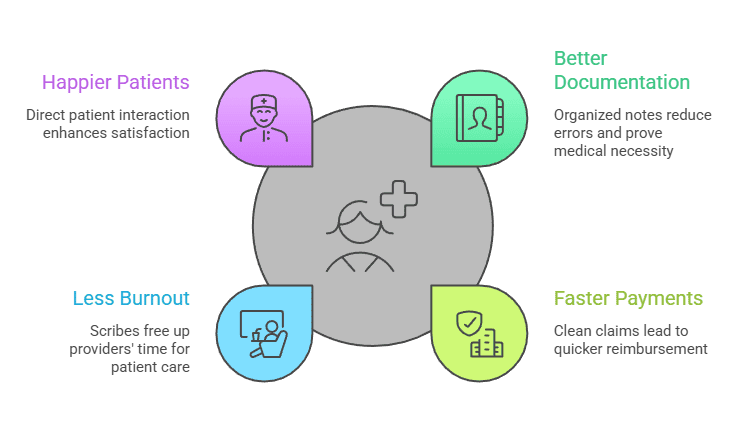
The Real Benefits of Medical Scribing
- Better Documentation, Fewer Errors
Clean, organized notes make coding easier and help prove medical necessity. - Faster Payments
Solid documentation means cleaner claims and less back-and-forth with payers. - Less Burnout for Providers
Charting all night wears doctors down. Scribes give them time back for patients. - Happier Patients
When doctors aren’t glued to laptops, they actually connect with the person sitting across from them.
Types of Medical Scribing Services
You’ve got options. Practices can use:
- Virtual scribes (real-time, remote)
- AI-assisted scribing (tech that speeds things up)
- Onsite scribes
- Specialty-specific support
Pick what fits your practice and workload-the options flex with your needs.
How ScribeEMR Handles Medical Scribing
At ScribeEMR, medical scribing isn’t just someone typing up notes. It’s a full documentation solution. Here’s what’s in the mix:
- Virtual scribes
- AI and AI-assisted scribing
- Medical coding support
- Revenue cycle management
- Virtual office help
Our team works right inside your EMR, making documentation faster and sharper. Practices working with us see:
- More claims approved
- Smaller backlogs
- Quicker chart completion
- Stronger, steadier revenue cycles
With experienced staff, smoother workflows, and smart technology, we help doctors escape paperwork and get back to their patients.
So, is medical scribing worth it?
For the large majority of providers: medical scribing keeps charts accurate, speeds up payments, and takes a load off doctors. As documentation gets more complicated, scribes help doctors focus on what matters.
If you need a documentation partner who can keep up with today’s challenges (and tomorrow’s), ScribeEMR is ready to help.
References
- American Medical Association (AMA), 2023-2024 EHR and Administrative Burden Reports
- Optum 2024 Revenue Cycle Denials Index
- Experian Health State of Claims Survey
- Gallup Workplace Insights Report, 2024