
Tasks that Virtual Medical Agents Can Handle to Support Rural Health Facilities
Tasks that Virtual Medical Agents Can Handle to Support Rural Health Facilities
In rural practices, a single front-desk or administrative vacancy can disrupt an entire clinic. Front-end operations, appointment scheduling, referrals, prior authorizations, registration, and patient communication, when not handled expeditiously, escalate to missed calls, delayed authorizations, and incomplete referrals. They contribute directly to missed routine or critical care, lost revenue, and staff burnout.
Federally Qualified Health Centers (FQHCs) and Community Health Centers (CHCs) are being pressured to consolidate administrative roles due to lack of staff and funding shortfalls. One individual may handle check-in, scheduling, referrals, phone calls, and insurance verification simultaneously.
To meet staffing shortfalls, rural health organizations are automating these and other administrative functions with HIPAA-compliant virtual medical agent (VMA) services. Virtual Medical Agents for Rural Health Facilities are increasingly being adopted to handle administrative workflows that don’t rely on constrained local workforces and no longer support traditional staffing models.
For example, a two-provider rural clinic can access the same trained administrative resources as a large urban practice, with standardized coverage and consistent response times. This model does not replace local staff, but it allows on-site teams to focus more on patient-facing work while offloading time-intensive administrative processes. For FQHCs and CHCs, where administrative requirements are complex and patient volumes are high, Virtual Medical Agents for Rural Health Facilities can help bridge the gap in administrative workflow.
VMA Privacy and Patient Protections
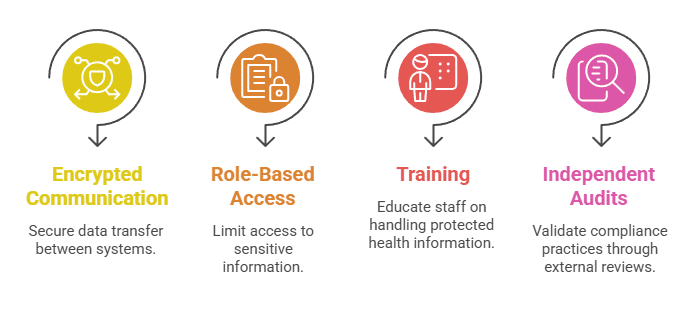
Effective HIPAA‑compliant VMAs incorporate encrypted communication across systems, role‑based access within electronic medical records, training in handling protected health information and independent audits to validate compliance practices.
For rural organizations serving federally funded populations or operating across multiple states, documented compliance provides assurance during payer reviews, audits, and regulatory inquiries. It also reduces organizational risk as administrative capacity expands beyond physical clinic walls.
Administrative Tasks That Can Be Managed Virtually
Here are seven common tasks that a ScribeEMR’s VMA tools can assist with:
1. Appointment Scheduling and Confirmation
Proactive scheduling support and confirmation outreach are associated with 10–20% reductions in no‑show rates. In rural settings, where same‑day schedule backfills are unlikely, these gains meaningfully affect care continuity and revenue.
2. Prior Authorization (PA)
Prior authorizations are one of the greatest challenges for rural healthcare. According to the American Hospital Association 60% of rural practices require at least three employees to manage PA requests, and 35% spend over 35 minutes per request, which is unsustainable for smaller, independent rural clinics.
PA frequently causes delays in treatment and patient transfers, with 39% of chronically ill patients identifying it as their largest care burden. Rural populations often rely more heavily on Medicare and Medicaid compared to urban populations. These programs come with strict prior authorization requirements, creating additional hurdles for rural hospitals that already have fewer administrative resources to manage complex payer rules.
For rural practices without dedicated authorization staff, this work often falls to nurses, medical associates, or providers themselves. The result is delayed care, higher denial rates, and additional rework that compounds administrative strain.
Virtual medical agents trained in payer‑specific authorization workflows can assume these tasks centrally submitting requests, tracking responses, and escalating issues before denials occur reducing downstream impact on clinical teams.
3. Referral Coordination
Patients in rural areas often require specialized treatments or transfers to larger medical centers. In time-sensitive cases-such as cardiac issues, cancer treatments, or complex surgeries-these delays can be life-threatening. ScribeEMR’s VMAs can manage in‑network referral workflows end‑to‑end, improving follow‑through and reducing revenue leakage associated with out‑of‑network care.
4. Patient Registration
Accurate pre-visit registration reduces day‑of delays and billing errors, not to mention additional time for patients filling out forms in waiting rooms. Practices implementing pre‑visit registration workflows commonly report 5–10% improvements in patient satisfaction.
5. Chart Preparation
The VMA medical service team logs into the EHR like ECW or Athena Health and reviews the daily schedule approximately 5 days in advance. They review each patient’s chart, verifying the chief complaint, visit reason, and previous provider notes, flagging any tests or labs that need follow up. Our virtual medical service team calls patients directly to explain the importance of completing pending labs, imaging, or referrals well before their appointment.
The VMA will also follow up with labs and diagnostic facilities to ensure all reports are received by providers. Pre‑visit chart preparation reviewing histories, updating problem lists, and confirming required documentation has been associated with up to 20% improvements in provider efficiency. For rural providers with full schedules, this translates directly into improved access.
6. Fax and Document Management
Despite reliance on EMRs, practice portals and other digital communication platforms, faxing is still an issue for practices, centralized virtual management of inbound faxes routing and indexing documents. In March, 2026, CMS initiated new rules to phase out faxes by May, 2028. The rule doesn’t extend to prior authorizations to date, but the CMS has indicated plans to address prior authorization standards in future rulemaking.
7. Patient Outreach
In rural areas, where patients live further from physicians which increases the likelihood of cancellation or missed appointments. Structured outreach for follow‑ups, preventive care, and chronic disease management helps re‑engage patients who might otherwise delay care.
Measurable Impacts of Reduced Administrative Workload
When administrative functions like those mentioned are balanced between onsite, and virtual services, rural practices often observe measurable downstream effects. These include:
- Reduced after‑hours work for clinicians
- Faster authorization turnaround times
- Improved appointment adherence
- More consistent referral completion
- Increased staff retention due to reduced burnout
These outcomes are not driven by technology alone but by workflow design. Virtual agents are most effective when integrated into existing protocols and aligned with practice‑specific standards, rather than operating as detached call centers.
Rural hospitals already face thin operating margins. For facilities already struggling with reduced patient volumes and higher uncompensated care rates, delays can create cash flow crises. Nevertheless, healthcare providers must still meet appropriate levels of care, responsiveness, and administrative accuracy to ensure patient satisfaction, and long‑term financial stability. VMAs are a useful option to accomplish that.
Paul Ferrazza, vice president of Coding Business Development at CodeEMR, is an accomplished healthcare executive with more than 15 years of experience in revenue cycle management and coding business development.