
Healthcare Administrative Burnout: Why It Happens, What It Costs, and How to Fix It
Healthcare Administrative Burnout: Why It Happens, What It Costs, and How to Fix It
People usually think of doctors and nurses when they hear “burnout in healthcare.” But let’s be real – healthcare administrative burnout is rising fast, and administrative teams are feeling the heat just as much.
Think about the schedulers, the billers, the folks at the front desk, and the people wrangling insurance approvals. These are the people dealing with endless prior authorizations, denied claims, nonstop patient calls, and rules that seem to change every other week. The pressure keeps building.
Industry research shows nearly 60% of administrative staff in healthcare are stressed out, mostly because they’re short-staffed and insurance processes are complex. Meanwhile, the average claim denial rate hovers between 10 and 15%. That just means more work for teams already stretched to their limits.
But here’s the thing – healthcare administrative burnout isn’t just a workforce issue.
It affects revenue, compliance, and patient experience. Ignoring it is no longer an option.
What Does Administrative Burnout Actually Look Like?
You see it in the numbers, but it’s about more than that:
- More claim errors
- Higher denial rates
- Slower reimbursement
- Missed patient calls
- Skyrocketing turnover
Behind every stat, there are real people. People staying late to fix mistakes that shouldn’t have happened, fighting to keep up with paperwork that just keeps piling up.
One revenue cycle manager put it like this: “We were spending more time fixing denied claims than we were submitting clean ones. All the follow-ups were wearing down our billing team.” Honestly, that’s the story almost everywhere right now.
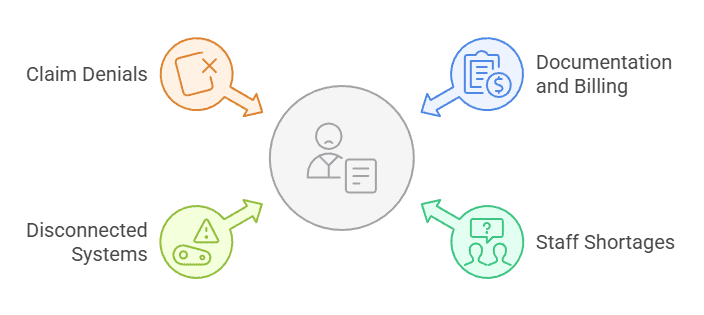
What’s Fueling Administrative Burnout?
- Documentation and Billing Keep Getting Harder
Insurance rules change constantly. Coding gets tighter. Compliance expectations rise. Every tweak adds more stress.
- Not Enough People
It’s not just nurses and doctors – admin teams are running lean, too. Many are forced to juggle more work without any extra help.
- Outdated, Disconnected Systems
When scheduling, billing, and EHRs don’t talk to each other, staff waste hours repeating the same tasks. Manual work means more mistakes and more frustration.
- Chasing Down Denials
Every denied or delayed claim ties up more money and more time. Staff spend hours on calls, corrections, and paperwork.
The Real Price of Administrative Burnout
Burnout drags down more than just morale:
- More denials
- Slower payments
- Unhappy patients
- People quitting
- Costs going up
Replacing just one admin employee can cost 20–30% of their salary – and that’s not even counting the time it takes to get someone new up to speed.
Patients see the cracks, too: long hold times, delayed bills, confusing statements. Burnout doesn’t just hurt staff – it chips away at trust.
So What Actually Helps?
There’s no magic fix, but there are real ways to make things better.
- Offload Routine Work
Remote teams can handle repetitive tasks like documentation, coding support, and billing follow-ups. That frees up your in-house staff.
- Go Virtual with Office Support
Virtual Medical Office Services (VMOS) let you scale up for:
- Scheduling
- Insurance verifications
- Billing and coding help
- Patient communication
You get flexibility, especially when things get busy.
- Streamline Documentation and Coding
Better documentation means fewer denials. Clear coding processes help get claims approved the first time.
A community health center told us, “After we set up structured coding and denial follow-up, claim approvals went up, and reimbursements got smoother. It took a huge load off our team.”
How ScribeEMR Steps In?
ScribeEMR offers:
- Virtual medical scribes
- AI and AI assisted medical scribing
- Medical coding support
- Revenue cycle management
- Virtual Medical Office Services
Our teams work right alongside yours, helping with documentation, reducing work from denials, and keeping operations steady.
One partner said, “Communication is clear and fast. Claim approvals have improved since we brought in the team.”
Another client told us, “Their steady processes and quick turnaround helped us stay afloat during a tough stretch.”
When admin pressure goes down, productivity and morale go up. It’s that simple.
Bottom Line
Administrative burnout isn’t just about being tired – it’s a sign that something’s broken. When billers and schedulers are overwhelmed, revenue slows, mistakes pile up, and patients notice.
But with smarter workflows, scalable virtual support, and stronger documentation, healthcare organizations can protect their people, their bottom line, and their patients.
References:
- AAG Health “HR in Healthcare: 61 Statistics and Trends for 2025” and Gallup 2024 Workplace Insights
- Optum 2024 Revenue Cycle Denials Index and Experian Health Reports
- The Resource Company: 2025 Healthcare Turnover Data
- Medical Group Management Association (MGMA) Stat Polls (2023-2025)
- American Medical Association (AMA) 2023/2024 Prior Authorization Survey