Best AI Scribe with Human Review: How Amplif.AI Adds Human Review to Any AI Scribe
It is nearly 8 p.m. The clinic closed hours ago, but the charting has not. You are still working through AI-generated notes that should have been done by mid-afternoon. One contains an incorrect medication, while another is missing an important assessment. So much for “automatic documentation.”
Finding the best AI scribe with human review can help address these challenges by combining AI-powered documentation with expert human oversight. Physicians spend nearly two hours documenting for every hour of direct patient care, and much of that time can be spent correcting or completing what an AI draft leaves behind.
Rather than replacing your AI scribe, Amplif.AI adds expert human review to every draft before the note reaches you. Unlike standalone AI tools, you continue to use your current AI platform you already trust, and ScribeEMR adds a human-in-the-loop layer, rather than forcing a complete workflow change.
Who This Is For
Amplif.AI is built for practices already using an AI scribe like Nuance DAX, Suki, Abridge, Heidi, ScribeRyte AI, or another – and are still losing provider time correcting drafts or finishing notes after hours.
What Amplif.AI Is - the Human Review Layer for Any AI Scribe
An AI scribe with human review pairs automated drafting with a trained scribe who checks the work – also called human-assisted AI scribing, a human-in-the-loop scribe, or ambient AI with human review.
Amplif.AI is that human layer: a dedicated team of medical scribes that sits on top of whatever AI you already run, reviewing and finishing every note. Most AI scribes stop at a draft. Amplif.AI handles everything around it.
Why Documentation Feels So Heavy
The burden is well documented. The AMA reports family physicians add about 86 minutes of after-hours “family time in the chart each night, and documentation is repeatedly named the leading driver of physician burnout. By industry estimates, that lost time can cost a practice around $57,500 in revenue per provider each year.
Where AI-Only Scribes Fall Short
Speed is not accuracy. Researchers examining OpenAI’s Whisper model – behind a widely used medical scribe – found fabricated text in up to eight of ten transcriptions, including a medication no clinician mentioned. And even when the draft is clean, pre-charting, note scrubbing, and EHR entry still land on the physician. A confident-sounding error is more dangerous than an obvious blank – which is why a human review layer has become the safeguard automation alone cannot provide.
AI-Only vs. Human-Only vs. AI + Amplif.AI
Here is how the three approaches compare:
| Factor | AI-Only | Human-Only | Your AI + Amplif.AI |
| Turnaround | Fast | Slower | Fast |
| Accuracy check | None | Strong | Strong (human QA on every draft) |
| Hallucination risk | High | None | Low – caught in review |
| Billing / coding precision | Variable | Good | High |
| Specialty fit | Generic | Strong | Strong |
| Cost profile | Low list price, hidden rework | Highest | Balanced |
How Amplif.AI Works on Top of Any AI
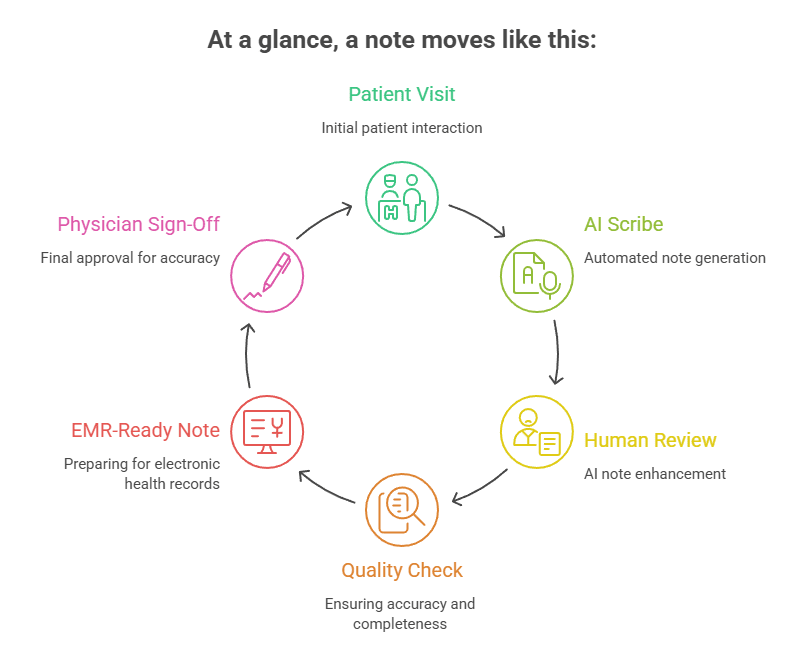
The workflow stays simple, and you keep your tools:
- Use the AI scribe you already run.
- Your AI captures the visit and generates a draft.
- A dedicated Amplif.AI scribe pre-charts, reviews and scrubs the draft, and pushes the final note to your EHR.
- You review the completed note and sign.
What Practices Gain
Physicians cut after-hours charting without giving up quality, and practices using Amplif.AI report saving one to two hours a day. Because you keep your current AI, there is no switching cost and no new platform to learn.
More complete documentation also supports accurate coding and fewer denials – where CodeEMR’s medical coding and revenue cycle management teams add value. The finished note also reads in the physician’s own voice, not a generic template.
Why Human Review Still Matters - Especially by Specialty
AI drafts tend to break down where documentation matters most. In orthopedics a model may garble laterality; in psychiatry it can flatten a mental status exam; in cardiology it may misread a medication titration; in OB/GYN it can drop gestational details that change the plan.
An Amplif.AI scribe catches these before they reach the record – the real line between AI-only platforms like Nuance DAX, Suki, and Abridge and the same tools with a human in the loop through sign-off.
The team behind Amplif.AI matters too. ScribeEMR has operated since 2016, supporting 20,000-plus clinicians and 380-plus organizations across 40+ specialties and 45+ EMRs.
Amplif.AI is HIPAA-compliant, SOC 2 Type II audited, and Best in KLAS three years running, with practices citing up to a 60% cut in documentation time and roughly 50% fewer errors. It layers on ScribeRyte AI or any other AI, and Virtual Medical Office Services extends support into scheduling and prior authorizations.
What Clinicians Say
“She has helped me increase the number of patients I see each day, up to 25 - a significant increase. Having a scribe also takes tasks off my plate.”
Sarah Waling,
DO, MPH“I never have to look away from the patient to document. At the end of clinic, all I do is review and sign off on my notes.”
Orthopedic surgeon,
six-year ScribeEMR clientKey Takeaways
- Even accurate AI still leaves pre-charting, scrubbing, and EHR entry to the physician.
- AI adds a human review layer on top of any AI scribe – no switching.
- It works with Nuance DAX, Suki, Abridge, Heidi, ScribeRyte AI, or any AI charting tool.
- AI is HIPAA-compliant, SOC 2 Type II, and Best in KLAS 2024–2026.
- Practices report up to 60% less documentation time and roughly 50% fewer errors.
Frequently Asked Questions
The human review layer for any AI scribe - a dedicated team that reviews and finalizes every AI-generated note before the physician signs.
Yes. It layers on top of Nuance DAX, Suki, Abridge, Heidi, ScribeRyte AI, or any tool - no switching required.
Yes. By removing after-hours charting and finishing notes before sign-off, it eases the documentation load most closely tied to burnout.
Yes. It is HIPAA-compliant and SOC 2 Type II audited, and audio is not retained after the note is generated.
Precision-heavy fields such as orthopedics, psychiatry, neurology, OB/GYN, and cardiology, where a small error affects coding or care.
No. Amplif.AI is the human layer, not another AI - you keep the tool you already use.
Practices using Amplif.AI report saving one to two hours a day on documentation.
The Bottom Line
AI is remarkably good at producing first drafts. What it still cannot replace is clinical judgment – or the work that surrounds the note. Amplif.AI supplies both: a trained human who reviews every draft and finishes everything your AI leaves behind. For practices looking for the best AI scribe with human review, Amplif.AI delivers expert human oversight without requiring a switch from your existing AI platform.
Why Practices Choose Amplif.AI
- A named human-in-the-loop layer – not another AI or piece of software.
- Works with any AI scribe and any EMR – no rip-and-replace.
- Best in KLAS three years running (2024, 2025, 2026).
- Backed by 20,000+ clinicians and experience dating to 2016.
Ready to leave the clinic with your documentation already finished? See how Amplif.AI works with your existing AI scribe and delivers sign-ready notes – without replacing your current workflow.
References
- Sinsky C, et al. Allocation of Physician Time in Ambulatory Practice. Annals of Internal Medicine, 2016.
- Arndt BG, et al. Tethered to the EHR. Annals of Family Medicine, 2017 (AMA “pajama time”).
- Associated Press / MedPage Today reporting on Whisper hallucinations in medical transcription, 2024.
- KLAS Research. Best in KLAS: Virtual Scribing Services, 2024–2026.
- Amplif.AI, ScribeRyte AI, and client testimonials (scribeemr.com).