
AI Scribe for Doctors & Healthcare: How ScribeRyte AI is Transforming Clinical Documentation
Doctors spend so much time on documentation these days, it almost feels like the paperwork never ends. There’s the EHR to wrangle, endless coding rules, and a mountain of notes to finish for every single patient.
No wonder clinicians often find themselves typing late into the evening instead of actually connecting with the people they’re trying to help.
The sheer volume of admin work isn’t just exhausting – it’s a big reason for burnout and all those annoying delays in chart completion. Now, AI medical scribing is changing the game.
Tools like ScribeRyte AI combine smart automation with clinical know-how, helping doctors finish their notes faster and with less hassle. The result? More time with patients, less time hunched over a keyboard.
So, what exactly is an AI scribe?
It’s a system that uses artificial intelligence, natural language processing, and machine learning to listen in on clinical conversations and turn them into tidy, structured notes.
Unlike human scribes who have to type everything in real time, an AI scribe just observes the visit and generates the documentation automatically. This cuts down on manual charting and lets clinicians stay focused on the person in front of them.
ScribeRyte comes in two flavors: Instant and Plus. ScribeRyte Instant is all about speed. It listens to your patient encounters and spits out SOAP notes and visit documentation right away, no extra effort required.
If you want fast notes, easy EHR integration, and less time spent typing after hours, this is the option. It’s perfect for busy practices that don’t want to deal with a documentation backlog or hire more staff just to keep up with notes.
ScribeRyte Plus kicks things up a notch. Here, the AI drafts the clinical note first, then a trained human reviewer steps in to polish it and make sure everything’s accurate and compliant. This approach is great for organizations dealing with complex cases, specialty language, or strict audit requirements.
You get the speed of AI, plus the reassurance of human oversight.
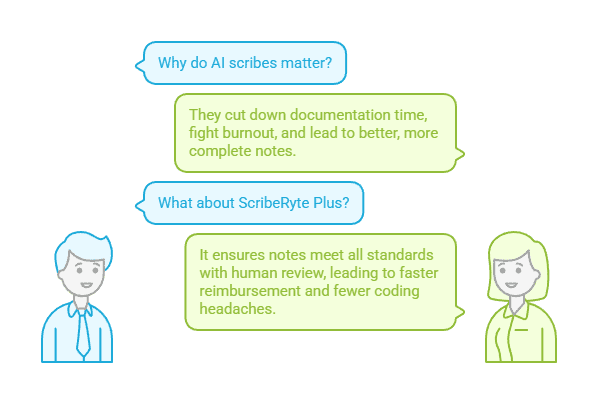
Why do AI scribes matter?
First, they seriously cut down documentation time. Clinicians often say charting eats up as much time as seeing patients – if not more. AI scribes like ScribeRyte handle most of the typing, so providers can get back to what really matters.
Second, they help fight burnout. When you take away those repetitive data entry tasks, stress levels drop, and clinicians get a bit of breathing room.
Third, you end up with better, more complete notes. This isn’t just about neat paperwork – it means clearer documentation for coding, fewer denials, and a smoother path to reimbursement.
With ScribeRyte Plus and its human review, you know the notes meet all the standards. And let’s not ignore the financial angle. Clean, accurate notes mean coders can do their job right, claims get processed faster, and there’s less time wasted fixing errors or fighting denials. Practices using ScribeRyte often see fewer coding headaches and quicker payments.
How does ScribeRyte AI fit into the daily workflow?
It’s pretty simple: The AI listens during the visit, or to a recording. – It creates clinical notes in standard templates like SOAP or H&P. – For ScribeRyte Plus, a human editor reviews and sharpens the notes. – Finished notes drop right into your EHR. This whole setup saves time, boosts accuracy, and keeps everything on track for compliance.
Providers already using ScribeRyte keep coming back with positive feedback. They’re spending less time catching up on charts after hours, closing charts faster, and feeling more focused on patients.
One group even said, “With automated note generation through ScribeRyte Instant, our daily charting burden dropped dramatically, and providers have more energy for patients.”
Another added, “ScribeRyte Plus helped us keep our documentation quality high while speeding up chart closure – especially for the tricky cases.” Worried AI will replace human scribes? That’s not really how it works.
AI scribes are tools to boost what people can do, not replace them. ScribeRyte Plus, for example, blends the speed of AI with the careful eye of a clinical reviewer. You get both efficiency and accuracy.
And about compliance – yes, AI-generated notes can be compliant, as long as the workflow includes human validation and checks for accuracy. With the right setup, ScribeRyte keeps documentation on point for coding and payer requirements.
What’s Next for Clinical Documentation?
AI scribing isn’t just a passing fad. It’s a big part of how healthcare is changing. As the tech gets smarter, expect documentation to get quicker, more accurate, and a lot less of a headache. It’ll also work better with decision support tools, making everything feel more connected.
ScribeRyte – whether you need Instant speed or Plus-level precision – has options for every practice, big or small, to help you keep up.
Should You Try AI Scribing?
If your clinicians spend too much time on paperwork, if admin costs keep creeping up, or if burnout is starting to show, it’s time to consider something new. ScribeRyte Instant and ScribeRyte Plus can take a real load off.
Here’s what you can expect:
✔ Less time spent on documentation
✔ Better, clearer clinical notes
✔ Help with coding and hitting revenue goals
✔ A better day-to-day experience for your providers
Take a look at how AI scribing can shake up your workflow and help your team focus on what matters most – caring for patients. Explore ScribeRyte AI today!
Whether you’re an individual provider or managing a multisite practice, adopting AI scribes can lead to significant clinical and financial ROI.